Contact lenses yield nothing, or do they?
Discover how a professional contact lens practice can contribute to greater profitability, stronger customer loyalty, and new growth opportunities.
Contact lenses hardly yield anything. They require a lot of time, margins are under pressure, and online providers make it increasingly difficult to compete on price.
These are statements I still regularly hear during my visits to optical shops.
But are we looking at the profitability of contact lenses in the right way?
What if we not only look at the margin on a box of lenses but at the total value of a contact lens customer for our optical shop?
Recent research results already give us an interesting reason to reassess our contact lens practice.
1. The figures speak: contact lens customers can be particularly profitable
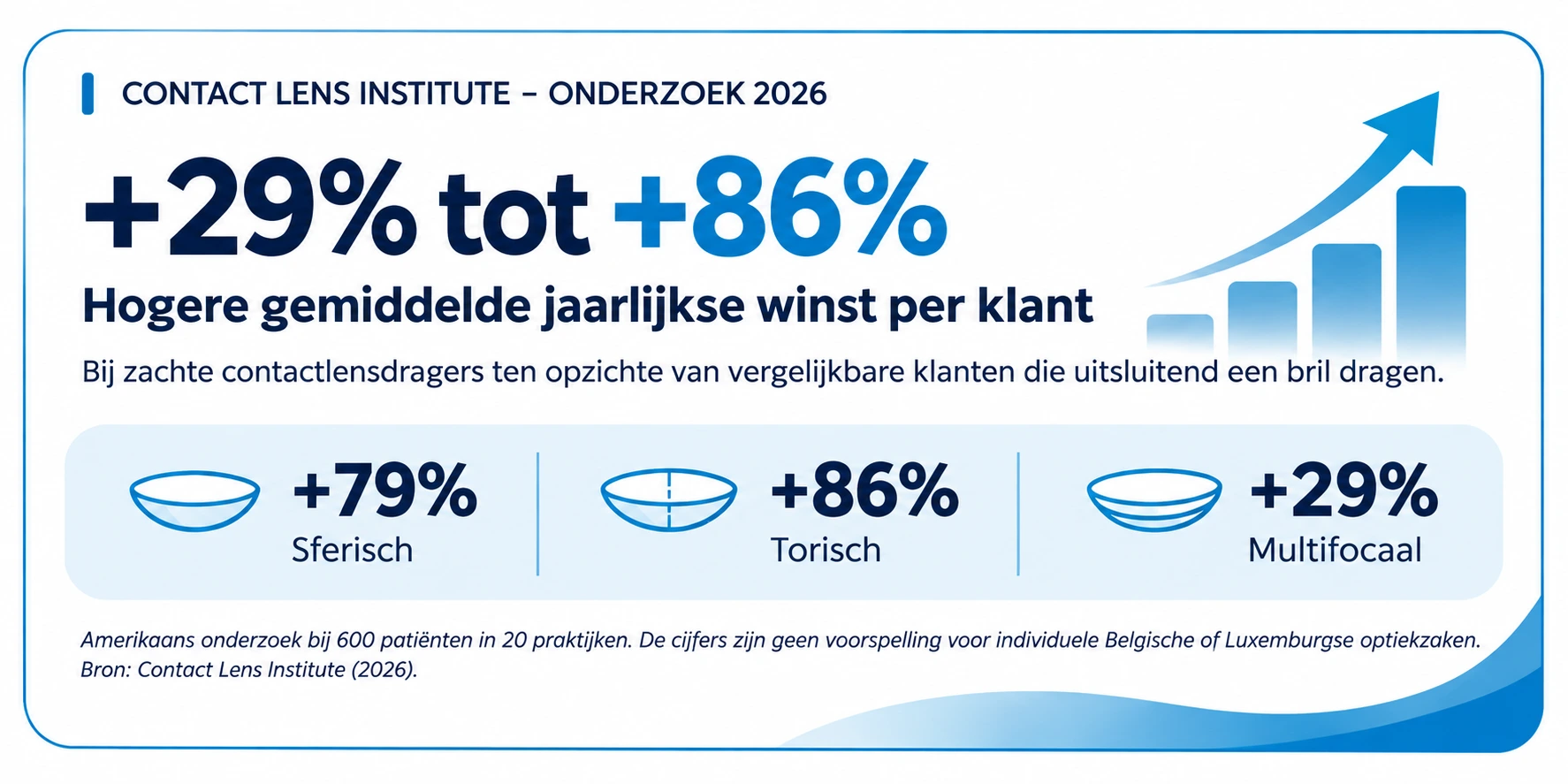
In 2026, the Contact Lens Institute published the report Profitability Perspectives: Rethinking the Value of Contact Lenses.
A research team, including Professor Philip Morgan (University of Manchester) and Professor Lyndon Jones (University of Waterloo), analysed four years of financial and operational data from 600 patients in 20 American optometry practices.
The results are remarkable.
Contact lens wearers generated, depending on their type of correction, an average of 29% to 86% more annual profit per customer than comparable customers who only wear glasses.
More specifically:
Spherical contact lens wearers: 79% more profit than comparable single vision glasses wearers.
Toric contact lens wearers: 86% more profit than comparable single vision glasses wearers.
Multifocal contact lens wearers: 29% more profit than comparable progressive glasses wearers.
The researchers took into account product costs, professional fees, fitting time, staff costs, and additional purchases.
So it is not just about turnover, but about the average profitability of the total customer relationship.
Of course, we cannot simply translate American results to the Belgian or Luxembourg market. Our rates, cost structures, and commercial habits differ.
But the conclusion remains particularly relevant:
The value of a contact lens customer goes far beyond the margin on the lenses themselves.
2. Do you sell contact lenses, or do you fit them?
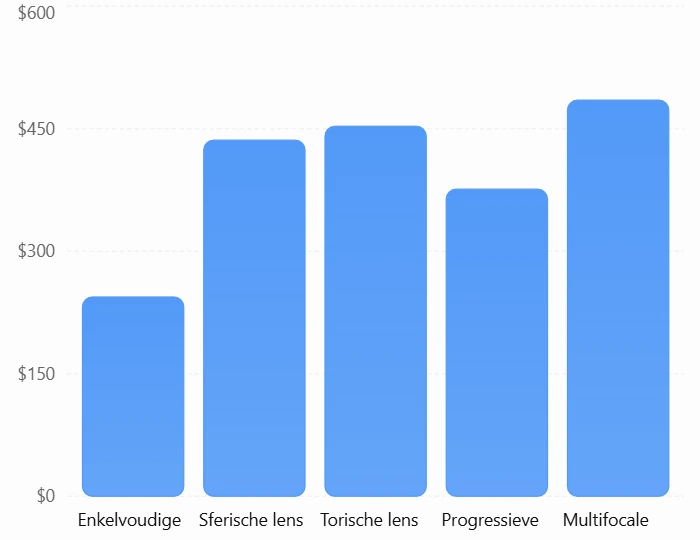
Perhaps this is the most important question we as eye care professionals should ask ourselves. Selling a box of contact lenses can almost be done by anyone nowadays. But a good contact lens fitting requires knowledge, experience, time, and professional guidance.
A correct medical history, refraction, assessment of the tear film, choice of material, evaluation of the fit, and follow-up are not optional extras. They are professional services.
A contact lens fitting is not an additional sale. It is professional service with its own value.
And professional service has a value that is independent of the price of the product.
Yet, contact lens fittings and check-ups are still offered for free or for a symbolic amount in some optical shops.
Why?
A profitable contact lens practice starts with a clear vision of professional service.
Work with transparent rates for initial fittings, follow-up checks, and specialised fittings. Make it clear to your customer what guidance they receive for that.
This is not only economically responsible, it also enhances your professional image.
3. A contact lens customer is more than a recurring order
A contact lens wearer regularly needs new lenses, but that is only part of the story. A well-guided lens wearer returns for check-ups, advice, and possibly new visual solutions. Moreover, contact lenses and glasses do not exclude each other at all. On the contrary.
Many customers combine both corrective means, depending on their activities, work, or lifestyle.
A contact lens wearer may also need glasses or sunglasses. A glasses wearer may discover contact lenses as a supplement for sports, leisure, or special occasions.
Those who actively offer both options create more choice for their customers and more opportunities for their practice.
The Contact Lens Institute also emphasises the importance of dual wear: the combined use of glasses and contact lenses.
The greatest value comes not from selling one product, but from building a long-term relationship in which the customer can turn to the same eye care professional for their various visual needs.
4. How many opportunities are already in your customer base?
Not every growth opportunity requires new customers. Think about the customers who are already visiting you today.
The beginning presbyope who is increasingly struggling with their screen. The existing multifocal lens wearer who is not completely satisfied. The customer who once stopped wearing contact lenses due to comfort issues. The young myope who needs professional guidance. Or the glasses wearer who has never been informed about the possibilities of contact lenses.
How many of those customers have you actively approached about contact lenses in the past year?
Contact lens technology has undergone significant developments in recent years.
New materials, EDOF technology, specialised soft lenses, rigid gas permeable lenses, orthokeratology, and scleral lenses offer increasingly more possibilities. That does not mean that every innovation is suitable for every customer.
It does mean that we as eye care professionals have more tools at our disposal to seek an appropriate solution.
It is not the lens itself that makes the difference, but the knowledge with which you select, adjust and follow up on them.

Perhaps you do not need to seek more customers, but you can mean more to the customers you already have.
5. Five ways to make your contact lens practice more profitable
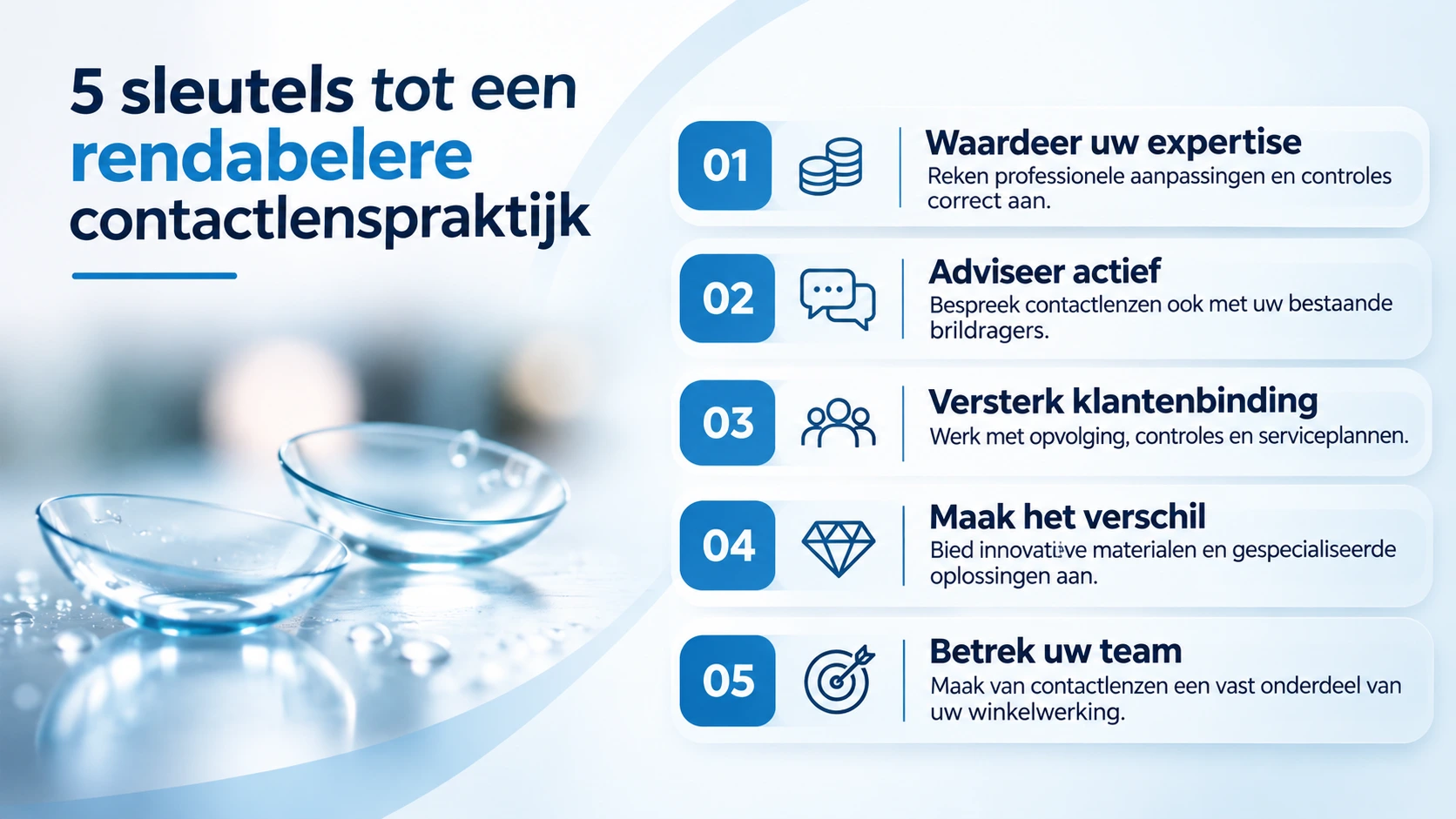
1. Give your professional expertise a clear value.
Distinguish between product prices and professional services. Work with transparent adjustment and control rates, tailored to the time and expertise required.
2. Make contact lenses an active part of your advice.
Do not wait for the customer to ask for contact lenses themselves. Discuss the possibilities during your advisory conversations, even with existing glasses wearers.
3. Invest in follow-up and customer retention.
Schedule check-ups, evaluate wearing comfort and inform customers about new possibilities. Consider a clearly defined service plan that combines professional guidance and regular follow-up.
4. Differentiate yourself through quality and specialised solutions.
Do not try to compete solely on the price of standard lenses. Build expertise in innovative materials, presbyopia, toric corrections and specialised fittings.
5. Involve your entire team in your contact lens practice.
A successful contact lens practice is not only the responsibility of the contact lens fitter. Staff who receive, advise and guide customers can also recognise opportunities and make a difference.
6. The Lens Tailor: more than a supplier of contact lenses
With The Lens Tailor, I want to support independent opticians in developing a professional, high-quality, and profitable contact lens practice. Not by solely offering products, but by thinking along with them about the possibilities within their own practice.
My range includes innovative soft contact lenses with special material properties, solutions with EDOF technology, specialised lens designs, and fully customised contact lenses.
From daily soft lenses to rigid gas permeable, orthokeratological, and scleral solutions.
But a wide range only has value when you know how to apply those possibilities in practice. Therefore, I find personal guidance, training, and practical support at least as important as the product itself.
My goal is not simply to make you sell more contact lenses, but to successfully fit more customers together.
7. What if we adjust contact lenses together?
That is why I want to focus even more on practical contact lens fitting days with independent opticians in 2027.
No classic product presentation where you just come to listen to new lenses.
But a real practice day, at your shop, together with your team and your own customers.
We can re-evaluate existing contact lens wearers, fit new candidates, guide presbyopic customers, and discuss challenging fittings.
You know your customers, their expectations, and their visual needs.
I bring my experience as an optometrist, my expertise in contact lens fittings and a wide range of trial lenses and specialised solutions.
Together we look for suitable solutions and strengthen the knowledge within your team.
And your customers? They experience up close what professional expertise your optical practice has to offer.
2027: time to give your contact lens practice a boost!
The end of the year is the ideal time to reflect and make new plans.
Perhaps it is also the moment to view your contact lens practice from a different perspective.
How many customers are wearing contact lenses today? What professional services do you charge for? How do you organise your follow-up? What opportunities are you still leaving untapped?
Perhaps you do not need to seek more customers, but you can mean more for the customers you already have.
The Lens Tailor would be happy to help you with that.
Invite me for a contact lens fitting day at your store and let’s discover together what possibilities your practice has to offer.
Fitting together. Learning together. Growing together.
Your customer wants lenses, we take care of it.
The Lens Tailor — your partner in contact lenses, expertise and practice development.
LET'S GET STARTED IN 2027
Give your contact lens practice a boost in 2027!
What if we fitted contact lenses together?
Invite The Lens Tailor for a practical contact lens fitting day in your store. We work together with your team, on your own customers, with innovative lens designs and specialised solutions.
Adjusting together, Learning together, Growing together.
Your customer wants lenses, we arrange it.